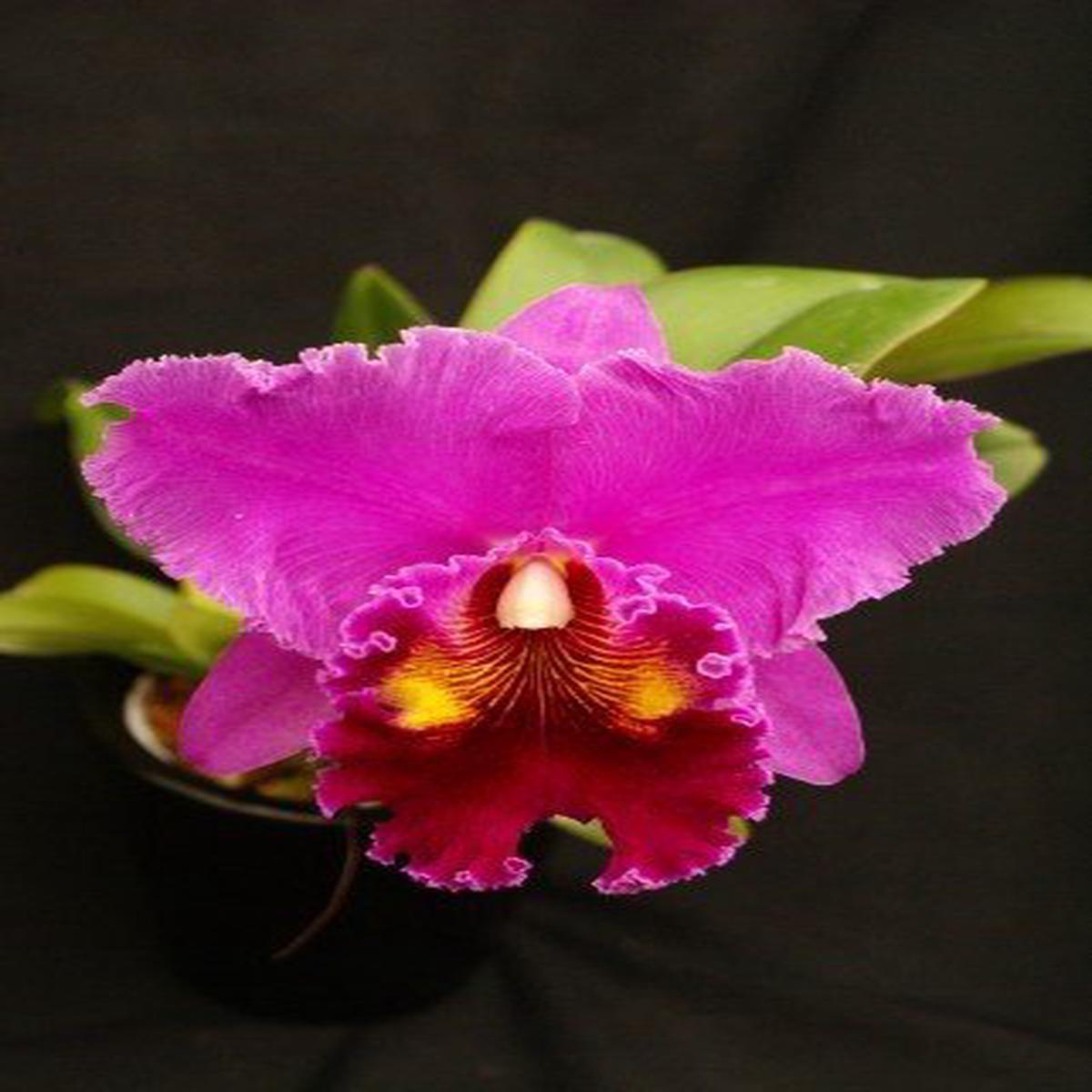

Laelia pumila is a compact orchid species with remarkably large flowers relative to its size. Beloved for its rich color contrasts and delightful fragrance, this botanical rarity is a special addition to any collector of miniature orchids.
This species is native to southeastern Brazil, where it grows on tree branches in the Atlantic forest at altitudes between 800 and 1500 meters. There it enjoys bright light, good air movement and short, humid seasons with dry winters. Originally described as Laelia pumila, it is also placed under the genus Cattleya in some modern systems.
Laelia pumila remains small in size, with short, egg-shaped pseudobulbs and one leathery leaf per bulb. What makes her so special are the large flowers of 8 to 10 cm wide, which look surprisingly large for such a compact plant. The inflorescence usually bears one flower per stem. The color ranges from soft pink to intense purple, often with a deeper colored lip and subtle markings. The fragrance is sweet and floral. Several natural variations exist, including the white form (alba) and the dark purple (rubra).
Give this species plenty of bright, filtered light. A bright windowsill facing east or west is ideal. Direct afternoon sun can burn the foliage.
Laelia pumila tolerates both warm and cool conditions, but does best at day temperatures between 20-25C and night temperatures around 12-16C.
Use a very aerated epiphyte substrate based on coarse bark or mount it on cork or wood, as in its natural habitat. Ensure good drainage and air circulation around the roots.
This species appreciates a humidity of 50-70%. When humidity is low, provide regular misting or use a humidifier.
Give a highly diluted orchid fertilizer weekly during the growing season (spring and summer). Preferably use a fertilizer without lime and rich in potassium and phosphorus for better flowering.
Allow the substrate to dry briefly between waterings. Always use demineralized water (possibly mixed with clean rainwater). During the winter months, the plant may be kept slightly drier.
Flowering usually occurs in late summer or early fall, often on that year’s new growth. Each pseudobulb can produce one beautiful flower. After flowering, a rest period is important for bud formation the following season.
Only logged in customers who have purchased this product may leave a review.