$29.00
$58.00
50% OFF! Hot items selling fast—Grab them before they're gone!
 Unconditional Satisfaction GuaranteeNo Shipping Fees Above 302 Months to Decide. Returns Simplified.
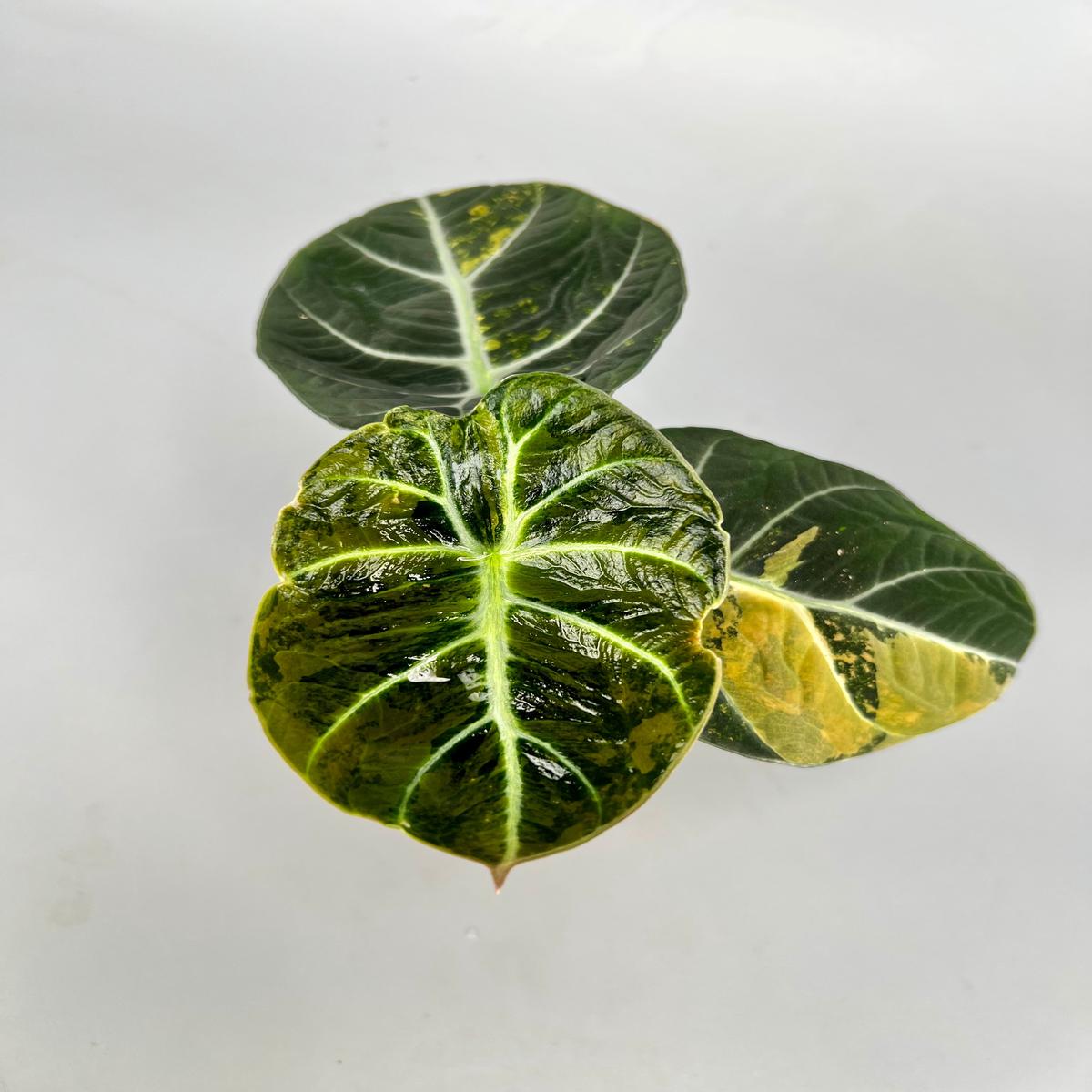
The Alocasia ‘Black Velvet’ aurea variegata – Big Plant is a rare, fully mature specimen of this coveted variety. Where the standard Black Velvet already impresses with its velvety, almost black leaves and silvery-white veins, this one adds aurea-variegata adds a unique color accent: bright yellow to golden yellow variegation distributed unpredictably across the leaves.
This is a mature plant, with multiple leaves and a solid root ball – not a tuber or young cutting. Ready to be an instant showpiece in your collection.
The base of this cultivar is Alocasia reginula, a species from Borneo known for its compact growth and dark leaf color. The aurea-variegata is a rare mutation found only in culture. The striking yellow color is caused by the lack of chlorophyll in certain cells, which creates unique leaf patterns that are different on each plant.
The plant grows compactly with short petioles and thick, velvety leaves of 10-15 cm long. Leaf color is deep black-green to anthracite, with silvery-white veins and irregular sectors, spots or streaks in yellow to golden yellow. These color contrasts make each plant unique.
Due to the limited chlorophyll content in the yellow parts, the plant grows more slowly than the green form, but this is more than offset by its aesthetic value.
Bright, indirect light. Avoid direct sunlight to prevent burning of the variegated parts. Too little light can reduce yellow variegation.
Ideally between 20-27 C. Do not expose to temperatures below 16 C. The plant likes a consistently warm, draft-free climate.
Airy, humus-rich and well-draining. A mix of coconut fiber, fine bark, perlite and a little activated charcoal is ideal. Do not leave the roots in wet soil.
65-85%. The plant appreciates high humidity, especially in warm conditions. In dry air, a bell jar or humidifier are recommended.
During the growing season (spring to fall) fertilize lightly every 3-4 weeks with a balanced foliar plant food. In winter, feed moderately or pause.
Use demineralized water or rainwater. Keep the substrate slightly moist, but always allow the top layer to dry out between waterings. Too wet = risk of rot.
Flowering is rare and not very graceful. The typical arum is better removed to keep energy in leaf growth.