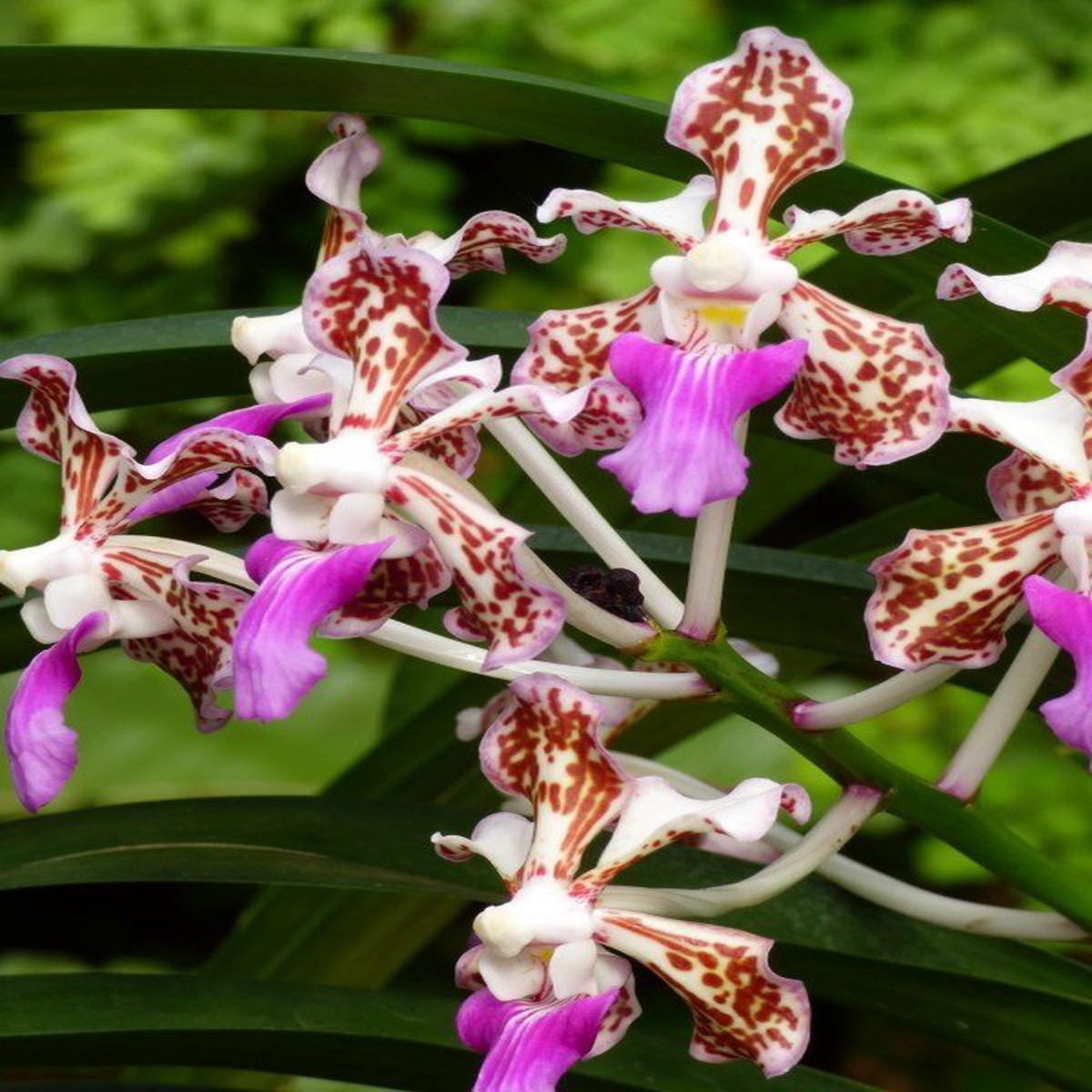
The Vanda tricolor is a botanical beauty with a rich history. Known for its long flower clusters and unique color pattern, this rare orchid has been admired in greenhouses and collections around the world for generations. A species for the true enthusiast who loves characterful plants with exotic appeal.
The Vanda tricolor is native to the mountainous regions of Java and Bali in Indonesia. There it grows at altitudes between 800 and 2000 meters as an epiphyte, often hanging in trees where it benefits from light, fresh air and morning mists. Because of its natural habitat, this orchid is well adapted to cooler but clear climates.
This species is notable for its long, drooping flower clusters with flowers that can grow up to 7 cm in size. The petals are mostly white or cream with purple-brown spots, and the lip shows a contrasting yellow with lilac. The fragrance is sweet and distinctly perceptible, especially during the day.
The Vanda tricolor grows monopodially with firm, leathery leaves arranged neatly in two rows along the stem. Unlike many modern Vanda hybrids, this variety grows a bit slower and requires a bit more attention.
Provide plenty of bright, filtered light. Direct sunlight in the morning or late afternoon is well tolerated, but bright afternoon sun should be avoided to prevent leaf burn.
Ideal daytime temperatures are between 20 and 28C, with nights around 15 to 18C. This orchid appreciates a clear temperature difference between day and night, as it experiences in its natural environment.
The Vanda tricolor grows best without substrate, hanging in a wooden basket or on a block, allowing the roots to dry well between waterings. Optionally, a very airy mix of bark can be used, provided it dries quickly.
High humidity of at least 65% is ideal. In drier conditions, regular misting helps, especially in the morning hours.
During the growing season (spring and summer) feed weekly with a highly diluted orchid fertilizer. In fall and winter, this may be reduced to once every two weeks.
Give demineralized water or rainwater as soon as the roots have completely dried up. In warm months, this may be daily, while in cooler periods, 2-3 times a week will suffice. Dip the roots briefly or water them thoroughly in the morning.
Flowering usually occurs in fall or winter, but under ideal conditions it can bloom in other seasons as well. Flower clusters can grow as long as 30 cm, with several fragrant flowers per cluster.
Only logged in customers who have purchased this product may leave a review.